
Introduction
A tenant in Dubai once signed a lease renewal without reading the amended clause on maintenance responsibility — a single line that shifted an AED 15,000 repair bill onto him. A small business owner brought in a partner using a two-page “agreement” downloaded from the internet, and eighteen months later, when the partnership fell apart, neither party could point to a clause covering profit split. These aren’t rare stories. They happen because a document looked complete on paper but wasn’t built to hold up when something went wrong.
That’s really what legal document services are about — not paperwork for its own sake, but documents that protect the people who sign them. This article walks through what these services cover, the types of documents most commonly needed in the UAE, how the drafting and review process actually works, and what to watch for before you sign anything.
What Are Legal Document Services?
Legal document services cover the drafting, reviewing, and, where required, the notarisation, attestation, or translation of documents that carry legal weight — meaning they create obligations, transfer rights, or can be relied on in a UAE court or before a government authority.
There’s a real difference between typing up an agreement and drafting one properly. Typing up a document means putting terms into a Word file. Drafting means thinking through what happens if either party doesn’t perform, who bears which risk, what law governs the relationship, and how a dispute gets resolved if it comes to that. A document that only describes what both sides hope will happen isn’t doing its job.
Types of Legal Documents Commonly Prepared
Contracts and Agreements
This is the largest category — commercial agreements, service agreements, partnership agreements, shareholder agreements, non-disclosure agreements, memorandums of understanding, and employment agreements. Each has its own risk points; a shareholder agreement, for instance, needs to address exit mechanisms and deadlock scenarios that a simple service agreement never touches.
Legal Notices
Notices — for termination, breach of contract, or eviction — need precise wording. A poorly worded notice can be challenged on procedural grounds alone, regardless of whether the underlying complaint is valid.
Powers of Attorney
A POA is only as good as its scope. “General” authority sounds convenient but can create real exposure if the agent oversteps. The powers granted, and their limits, should be spelled out rather than assumed.
Corporate and Business Documents
Memorandums of association, board resolutions, and other corporate documentation need to align with what’s actually filed with the relevant licensing authority — mismatches cause delays later.
Property-Related Documents
Sale and purchase agreements, tenancy contracts, and related documentation vary depending on the emirate and the authority involved, so specifics should always be confirmed against the applicable process rather than assumed to be uniform across the UAE.
Employment-Related Documents
Employment contracts, offer letters, and termination documentation need to reflect the terms actually agreed and stay consistent with applicable labour regulations.
Why Proper Drafting Matters in the UAE
Most document disputes trace back to a handful of recurring problems: vague clauses that can be read two ways, obligations that are implied but never written down, termination provisions that don’t specify notice periods, and no clear statement of governing law or jurisdiction. Add a business relationship that spans more than one emirate, or involves parties from different countries, and ambiguity becomes expensive fast.
Compliance matters too. A document that looks fine contractually but conflicts with a regulatory requirement can create problems that have nothing to do with what the parties intended.
Drafting vs. Review — They’re Not the Same Thing
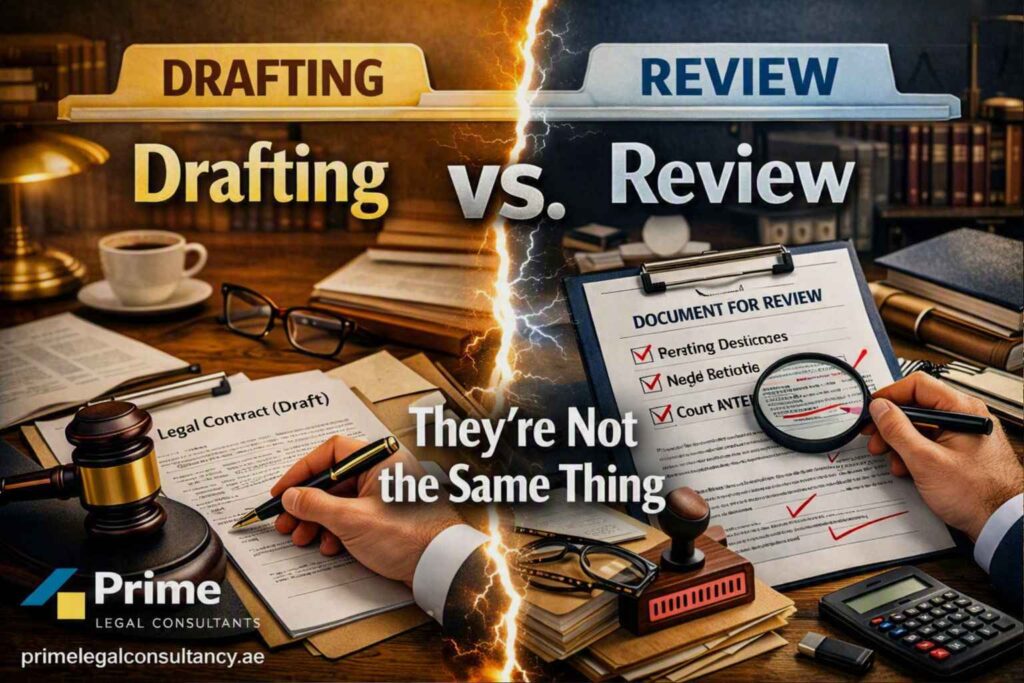
Drafting starts from a blank page: understanding the deal, then building the document around it.
Review starts with something already written — often a contract handed over by the other party — and checks it for one-sided clauses, missing protections, or wording that doesn’t match what was verbally agreed. Review is just as important as drafting; plenty of disputes involve a contract someone signed without a proper read-through, not one they wrote themselves. Translation is a separate step again — accurate wording in another language doesn’t automatically mean the terms are enforceable or well-drafted.
How the Document Preparation Process Works
While the specifics depend on the document and transaction, the general flow looks like this:
- Understanding the objective — what the document needs to achieve
- Gathering relevant facts, parties, and terms
- Identifying applicable legal and regulatory requirements
- Drafting or reviewing the document
- Revising clauses based on feedback
- Final review before signing
- Notarisation, attestation, or certified translation, where applicable
- Keeping proper signed records
Common Mistakes to Avoid
- Using a generic template without understanding what each clause actually does
- Copying a contract format used abroad without UAE-specific review
- Leaving key terms — price, timeline, deliverables — vague “to be confirmed later”
- Skipping the termination clause entirely
- Getting party names or license details wrong
- Ignoring how disputes will be resolved if things go wrong
- Signing an amended version without comparing it to the original
- Assuming a translated document is automatically legally sound
When to Bring in a Legal Professional
Simple, low-stakes documents can sometimes be handled without much assistance. But anything involving significant money, ongoing obligations, shared ownership, employment relationships, or property is worth having reviewed by someone who deals with these documents regularly — before signing, not after a dispute starts.
Choosing a Legal Document Service Provider
Look for genuine UAE experience with your specific document type, not just general legal knowledge. A good provider explains clauses in plain language rather than in legal shorthand, is upfront about scope and cost before starting, and treats your information as confidential. Ask how they handle revisions and turnaround — vague answers here are usually a preview of how the engagement will go.
Legal Document Services for Businesses
Companies typically need documentation across several relationships at once — supplier and customer contracts, employment agreements, confidentiality agreements protecting internal information, partnership and shareholder documents, and notices tied to commercial disputes. Keeping these consistent with each other, and with what’s on file with the relevant authority, avoids contradictions down the line.
Legal Document Services for Individuals
Individuals commonly need a power of attorney, a tenancy agreement reviewed before signing, an employment contract checked, or a personal agreement (like a loan between individuals) put into writing properly instead of left as a verbal understanding.
FAQ About Legal Document Services
Q1: What are legal document services?
Ans: Legal document services help businesses and individuals prepare, review, draft, and organize contracts, agreements, notices, and other legal documents.
Q2: Why are legal document services important for businesses?
Ans: Professional legal document services help ensure agreements are clear, legally appropriate, and aligned with business requirements while reducing potential legal risks.
Q3: What documents can legal document services help with?
Ans: Legal document services can cover contracts, NDAs, employment agreements, legal notices, partnership documents, commercial agreements, and other business paperwork.
Q4: Can legal document services review existing contracts?
Ans: Yes, legal document services can review existing contracts to identify unclear terms, potential risks, missing clauses, and obligations that may affect your business.
Q5: When should I use legal document services?
Ans: You should consider legal document services before signing important agreements, starting a business relationship, or preparing documents involving significant legal or financial obligations.
Q6: How can I choose reliable legal document services in the UAE?
Ans: Choose legal document services from experienced legal professionals who understand UAE laws, provide tailored advice, and clearly explain the risks and terms involved.
Conclusion
A well-drafted document doesn’t just sit in a drawer — it’s what protects you if a relationship, deal, or employment arrangement doesn’t go the way it was supposed to. Getting it right the first time is almost always less costly than fixing it after a dispute has already started.
If you need a document drafted, reviewed, or prepared for notarisation or translation in the UAE, Prime Legal Consultancy can help you get it right — primelegalconsultancy.ae.