
Introduction
A dispute with a bank rarely feels urgent until a notice arrives, a facility is suddenly frozen, or a claim is filed against you in court. By that point, the amount in question, the paperwork, and the legal process can all feel overwhelming at once. Banking litigation is the area of law that deals with exactly this — disputes between banks and the businesses or individuals they lend to, guarantee, or serve.
In the UAE, banking relationships are built on detailed contracts, and disagreements over those contracts are common enough that both Dubai Courts and the DIFC Courts see a steady flow of banking-related cases each year. This guide explains what banking litigation actually covers, how it tends to unfold in the UAE, and what to think about if you find yourself on either side of a bank dispute.
What Is Banking Litigation?
Banking litigation is the legal process of resolving disputes between banks and their customers — including individuals, businesses, guarantors, and other financial institutions — through the courts. It covers everything from a bank pursuing recovery of an unpaid facility to a customer challenging charges, fees, or the terms of an agreement they signed.
It sits alongside, but is distinct from, banking regulation. Regulation governs how a bank must conduct itself; litigation is what happens once a specific disagreement between two parties needs a court or tribunal to decide it.
Common Banking Disputes in the UAE
Banking disputes in the UAE tend to fall into a few recurring categories:
- Loan and facility default — a borrower falls behind on repayments and the bank moves to recover the outstanding balance, sometimes alongside any security or guarantee attached to the facility.
- Disputed loan amounts — a borrower believes the bank has miscalculated interest, fees, or penalties, or applied charges that were not clearly agreed.
- Guarantee and security disputes — a guarantor is called upon to pay and disputes whether the guarantee was validly triggered.
- Mortgage and property finance disputes — disagreements over repayment terms, valuation, or the bank’s right to enforce security over a property.
- Trade finance and letter of credit disputes — disputes between businesses and banks over documentary compliance under letters of credit or bank guarantees.
- Cheque-related disputes — while cheque bounce cases in the UAE are now handled largely through civil rather than criminal proceedings following changes to the commercial transactions framework, they remain a frequent source of banking claims.
- Account freezing or blocking — a customer’s account is restricted, often linked to a dispute, a court order, or a compliance concern, and the customer wants to understand their options.
Not every disagreement with a bank needs to end up in court, but understanding which category a dispute falls into is usually the first step toward working out how serious it is.
How Banking Litigation Works in the UAE
Jurisdiction is the first question in almost any UAE banking dispute. Where a case is heard depends on the governing law and jurisdiction clause in the underlying agreement, and on whether either party is registered in a financial free zone. Onshore banking disputes generally proceed through the local courts — Dubai Courts being the most active for Dubai-based matters — while disputes connected to DIFC-registered entities or DIFC-law contracts may fall under the DIFC Courts instead.
Once jurisdiction is settled, a typical banking case moves through several stages: filing of the claim, an exchange of submissions and supporting evidence between the parties, court hearings (which in the UAE’s civil law system rely heavily on written pleadings and documentary evidence rather than oral testimony), and a judgment. Depending on the value and complexity of the claim, the court may also refer certain technical or financial questions to a court-appointed expert to review the accounts, interest calculations, or contractual compliance before a final ruling is issued.
Enforcement is a separate stage that follows judgment. A bank that wins a recovery claim, for example, still needs to take further steps to actually enforce it against the debtor’s assets, which is its own process with its own timeline.
Documents That Matter in a Banking Dispute
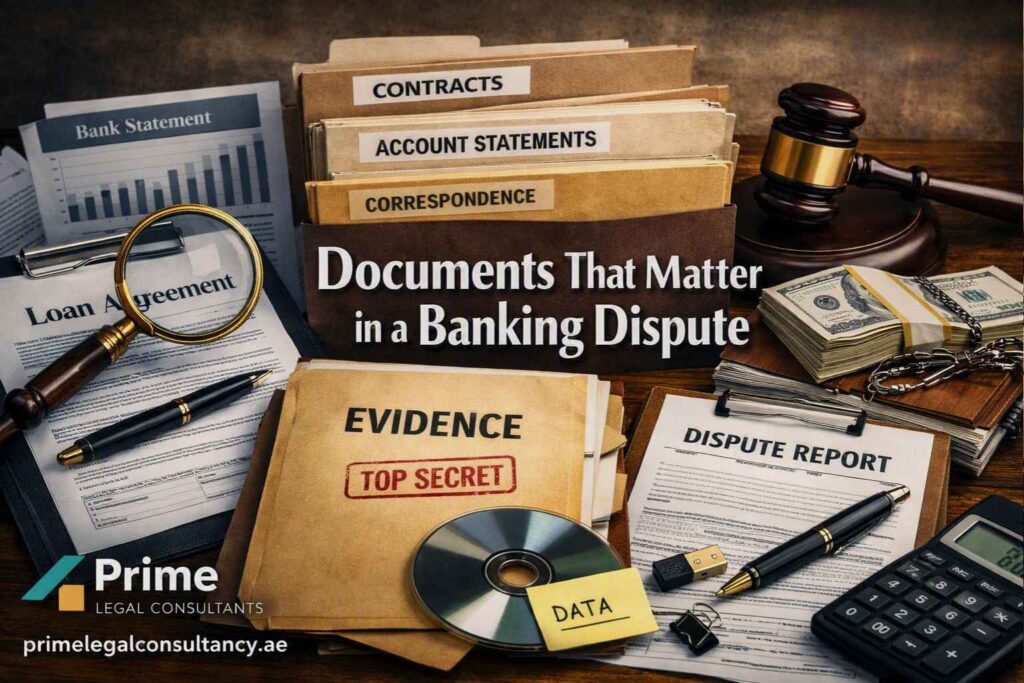
Banking cases are decided largely on paperwork, so gathering the right documents early makes a real difference. Relevant material usually includes:
- The signed facility, loan, or financing agreement and any amendments
- Security documents, such as mortgages, pledges, or guarantees
- Bank statements and transaction records
- Correspondence with the bank, including emails, letters, and formal notices
- Any settlement offers or payment plans previously discussed
- Records of any disputed charges, interest calculations, or fees
Can a Banking Dispute Be Resolved Without Going to Court?
Yes. Many UAE banking disputes are resolved through negotiation, structured settlement, or mediation before litigation becomes necessary. Banks are often open to restructuring a facility, agreeing a revised repayment schedule, or settling for a reduced amount, particularly where the alternative is a lengthy court process for both sides. Where a contract includes an arbitration clause, arbitration may also be the required route instead of court litigation.
That said, some disputes do need to go to court — particularly where the parties disagree fundamentally on liability, where a settlement offer isn’t realistic, or where a limitation period is approaching and formal proceedings are needed to protect a party’s position.
When Should You Speak to a Banking Litigation Lawyer?
It’s worth getting legal advice as soon as any of the following happen:
- You receive a formal notice or demand letter from a bank
- A court case has been filed against you, or you’re considering filing one
- Your account has been frozen or restricted unexpectedly
- You’re asked to honour a guarantee you believe wasn’t properly triggered
- You disagree with a bank’s calculation of what you owe
- You’re a business facing a dispute over trade finance or a letter of credit
Acting early generally gives you more options — whether that’s negotiating a resolution, correcting a factual error before it escalates, or simply understanding what a notice actually requires you to do.
Challenges Unique to Banking Cases
Banking disputes tend to be document-heavy and technical. Interest calculations, compounding, fee structures, and multi-party security arrangements can all get complicated quickly, and getting the numbers wrong in a submission can weaken an otherwise strong case. Cross-border elements are common too — a lender, borrower, or guarantor based outside the UAE adds questions about which law and which court actually applies. And because banks generally have in-house legal teams and established litigation strategies, individuals and smaller businesses are often at a disadvantage without experienced representation on their side.
Also Read: Expert Commercial Real Estate Lawyer Dubai
How Prime Legal Consultancy Can Help
If you’re dealing with a banking dispute in Dubai or elsewhere in the UAE, getting legal advice early can help you understand where you stand and what documentation you’ll need. At Prime Legal Consultancy, our team advises both individuals and businesses on banking disputes — from reviewing a bank’s claim and negotiating a settlement, to representing clients through court proceedings when a matter can’t be resolved otherwise. We also support clients on related matters such as debt recovery and general commercial litigation in the UAE.
This article provides general legal information and isn’t a substitute for advice on your specific situation — every banking dispute turns on its own contract terms and facts.
FAQ About Banking Litigation
Q1: Can a bank file a civil case in the UAE?
Ans: Yes, a UAE bank can pursue civil legal action to recover outstanding loans, credit card debts, or other unpaid financial obligations.
Q2: Can a bank file a case against credit card defaulters in the UAE?
Ans: Yes, banks may take legal action against credit card defaulters when payments remain overdue, subject to applicable UAE laws and procedures.
Q3: What are the banking laws in the UAE?
Ans: UAE banking laws regulate financial institutions, lending, payments, consumer protection, credit facilities, and banking compliance under the Central Bank framework.
Q4: Do banks refund scammed money in the UAE?
Ans: A bank may investigate reported fraudulent transactions and consider recovery or refunds depending on the circumstances, transaction type, and applicable banking rules.
Conclusion
Effective banking litigation in the UAE requires a clear understanding of the dispute, relevant agreements, supporting documents, applicable regulations, and the appropriate legal process. Whether the matter involves a loan dispute, financing agreement, debt recovery, credit facility, or disagreement between a bank and its customer, taking informed legal steps early can help protect your position and determine the most appropriate path toward resolution. For individuals or businesses facing a banking dispute in Dubai or elsewhere in the UAE, professional legal guidance can provide clarity on available options and the next steps.
Need help with a banking dispute? Contact Prime Legal Consultancy for professional guidance tailored to your circumstances. Our legal team can help you understand your options and approach your matter with a clear, practical strategy.