
Introduction
Launching a business in the UAE starts with selecting the right legal structure, licensing authority, and registration process. Mainland Company Setup in UAE gives entrepreneurs the flexibility to operate across the Emirates, work with government entities, and expand without many of the restrictions associated with other business jurisdictions. Whether you are a startup founder, an investor, or an established company planning regional growth, understanding the legal and administrative requirements from the beginning can save valuable time, reduce unnecessary costs, and prevent compliance issues later.
Every business has different goals, which is why the company formation process should never follow a one-size-fits-all approach. From selecting the right business activity and legal structure to securing approvals and obtaining the trade license, each step requires careful planning and professional guidance. At Prime Legal Consultancy, our experienced business setup specialists provide end-to-end support, helping entrepreneurs establish their mainland companies efficiently while ensuring full compliance with UAE regulations and long-term business success.
What Is a Mainland Company in the UAE?
A mainland company (sometimes called an “onshore company”) is a business entity licensed by the Department of Economy and Tourism (DET) — previously known as the Department of Economic Development (DED) — in the respective emirate. Unlike free zone companies, a mainland business is not restricted to operating within a specific zone. It can trade freely across the UAE, take on government contracts, and open branches anywhere in the country without needing a separate local agent for most activities.
This distinction is the reason so many serious traders, contractors, and service providers choose mainland registration over a free zone license. If your business model depends on dealing directly with the local UAE market — retail, contracting, consulting, healthcare, or logistics, for example — a mainland setup usually makes more commercial sense than a free zone one.
Mainland vs Free Zone: Which One Actually Fits Your Business?
This is the question we get asked most often, and honestly, the answer depends entirely on what you’re trying to build.
Choose Mainland if:
- You want to trade directly with customers anywhere in the UAE, not just within a free zone
- Your business will bid on government or semi-government contracts
- You plan to open multiple branches across different emirates
- You need physical retail or office presence accessible to walk-in clients
- You’re in a service industry like consulting, legal, healthcare, or education that requires local market access
Choose Free Zone if:
- Your business is primarily export-focused or digital with no local UAE clients
- You want 100% ownership without needing local market access (though this has changed for mainland too — more on that below)
- You prefer a faster, more standardized setup with bundled office packages
A good number of our clients actually end up running both structures side by side — a free zone entity for international operations and a mainland company for local trading. There’s no rule against that, and it’s a common strategy among established investors.
100% Foreign Ownership: What Changed and What It Means for You
For years, mainland companies required a UAE national to hold 51% ownership as a local sponsor. That changed significantly after the amendments to the Commercial Companies Law, which now allow 100% foreign ownership for most business activities on the mainland.
That said — and this is something people often overlook — not every activity qualifies for full foreign ownership automatically. Certain strategic sectors (like oil and gas exploration, banking, and some security-related services) still require Emirati participation or specific approvals. This is where working with a consultancy that actually checks your activity list against current regulations matters, because getting this wrong at the licensing stage can delay your setup by weeks.
Step-by-Step Process for Mainland Company Setup in UAE
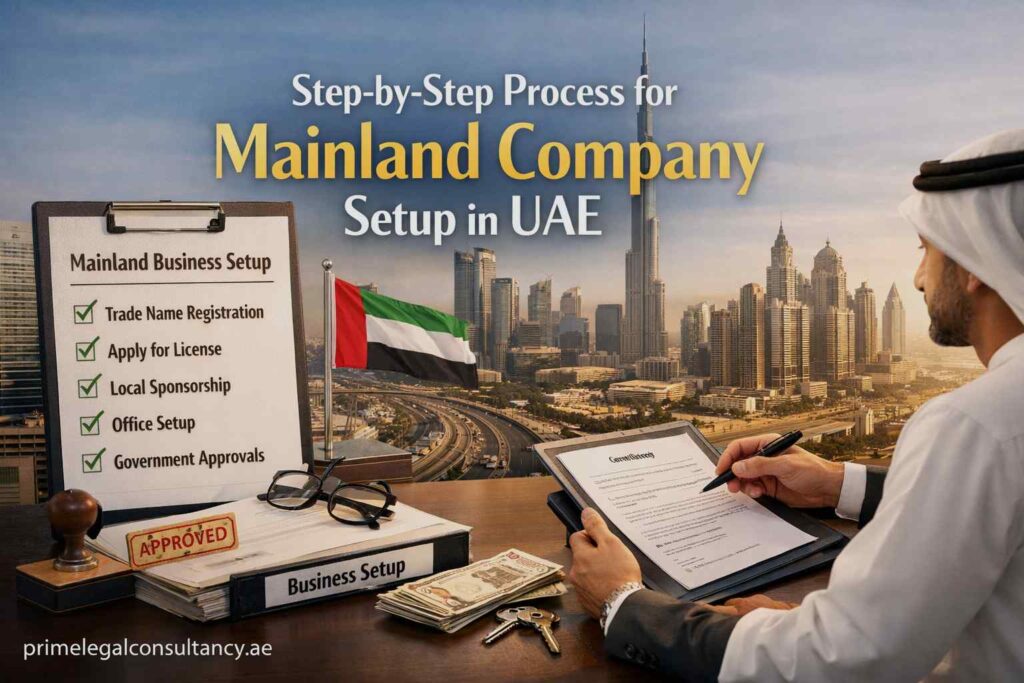
Here’s how the process typically unfolds when we handle it for a client, from initial consultation to receiving the trade license.
1. Choosing the Right Legal Structure
Common options include:
- Limited Liability Company (LLC) – the most popular structure for trading and service businesses
- Sole Establishment – suited for individual professionals and consultants
- Civil Company – for licensed professionals like doctors, engineers, and lawyers
- Branch of a Foreign Company – for international companies extending operations into the UAE
Picking the wrong structure at this stage is one of the most common (and costly) mistakes we see. It affects liability, ownership rules, and even how easily you can bring in investors later.
2. Selecting Your Business Activity
The DET maintains a list of over 2,000 licensable activities. Your trade license will be tied to the specific activity or activities you register, so this needs to be accurate — not just broadly worded. We’ve had clients come to us mid-operation because their original license didn’t actually cover a service they were already offering.
3. Trade Name Reservation
Your company name has to follow UAE naming conventions — no offensive or religious references, no abbreviations unless justified, and it must reflect the nature of the business if it includes generic terms. Reserving the name early prevents delays later.
4. Initial Approval from the DET
This confirms the government has no objection to you starting the business, though it isn’t the final license yet.
5. Drafting the Memorandum of Association (MOA)
For LLCs and civil companies, the MOA needs to be notarized. This document outlines ownership percentages, capital contribution, and the rights of each partner or shareholder.
6. Securing Office Space (Ejari/Tenancy Contract)
Mainland companies require a physical address registered under an Ejari tenancy contract. This can be a full office, a flexi-desk arrangement, or a warehouse, depending on your activity.
7. Final Submission and License Issuance
Once all documents are submitted — MOA, Ejari, initial approval, and any activity-specific approvals — the DET issues the final trade license.
Depending on the activity and how quickly documents are gathered, the entire process usually takes anywhere from 5 to 15 working days.
Documents Typically Required
- Passport copies of all shareholders and managers
- No Objection Certificate (if applicable, for UAE residents)
- Proposed trade name options
- Business plan (for certain regulated activities)
- Tenancy contract or Ejari
- Approvals from relevant authorities for regulated activities (healthcare, education, legal, etc.)
Requirements shift slightly depending on the emirate and the activity, which is why a document checklist prepared for one client rarely applies exactly to the next one.
Cost of Mainland Company Setup in UAE
There’s no single fixed number here, and anyone quoting you an exact figure without knowing your activity and structure is guessing. Costs generally depend on:
- Type of business activity and number of activities
- Legal structure chosen
- Office space size and location
- Number of visas required
- Whether the activity needs external approvals (e.g., from the Ministry of Health, KHDA, or other regulators)
As a general guide, mainland setup costs in Dubai typically start from around AED 15,000–20,000 for simple trading or consultancy licenses, with costs rising for regulated professional activities or larger office requirements. We always recommend getting a detailed quote based on your actual activity rather than relying on broad estimates found online.
Common Mistakes We See Businesses Make
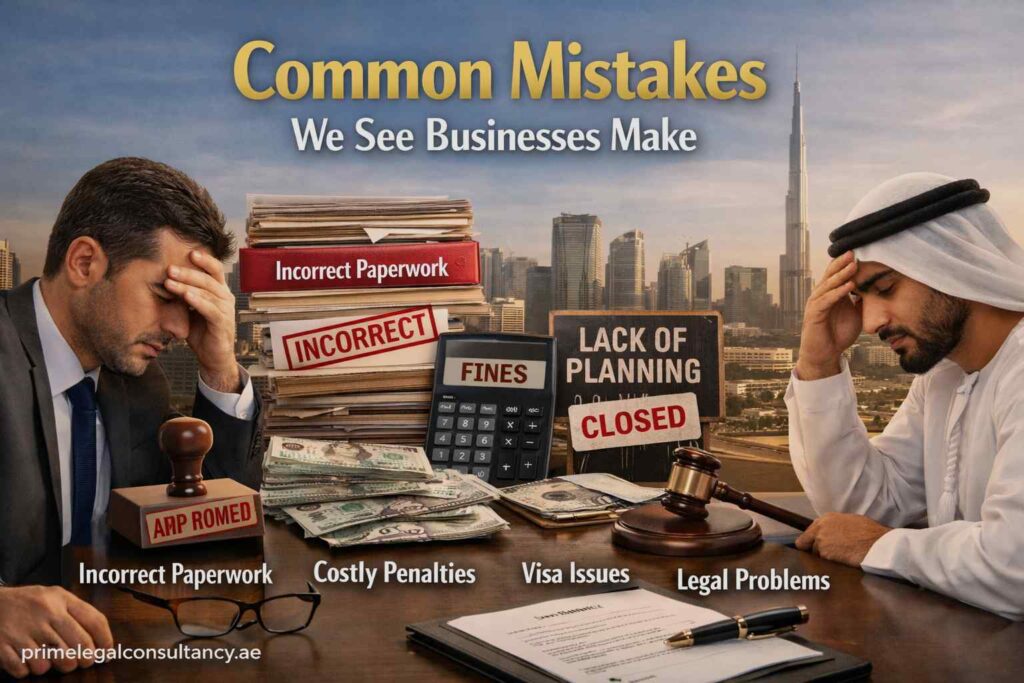
Underestimating activity classification. Choosing an activity that sounds close enough but doesn’t legally cover what you plan to do is a frequent and expensive error.
Ignoring approval timelines for regulated sectors. Healthcare, education, and legal services often need external authority sign-off, which can add weeks if not planned for.
Ejari mismatches. The registered office size sometimes doesn’t meet the minimum requirement for the number of visas requested, causing delays at the immigration stage.
Rushing the MOA. Ownership disputes down the line often trace back to a vague or rushed Memorandum of Association signed just to “get it over with.”
A little more time spent at the planning stage almost always saves significant time and money later.
Also Read: Trusted Business Setup Consultants in Dubai
Why Work With a Legal Consultancy Instead of Doing It Yourself
It’s entirely possible to handle mainland registration independently, and some entrepreneurs do. But the process involves coordination across multiple government departments, and regulations are updated more frequently than most business owners have time to track.
At Prime Legal Consultancy, our role isn’t just paperwork submission. We review your business model, confirm the right activity codes, structure ownership correctly from the start, and handle communication with the DET and other regulatory bodies on your behalf. For clients setting up regulated businesses — legal firms, medical clinics, or educational institutes — we also manage the additional authority approvals that free zone consultants typically aren’t equipped to handle.
FAQ About Mainland Company Setup in UAE
Q1: How much does it cost to set up a mainland company in Dubai?
Ans: The cost of Mainland Company Setup in UAE depends on your business activity, license type, approvals, and government fees.
Q2: How to set up a mainland company in the UAE?
Ans: Mainland Company Setup in UAE involves selecting a business activity, obtaining approvals, registering your trade name, and securing the required license.
Q3: What are mainland companies in the UAE?
Ans: Mainland companies in the UAE are licensed businesses that can operate across the UAE market and work with both government and private entities.
Q4: Can I set up a company in Dubai without living there?
Ans: Yes, non-residents can complete a Mainland Company Setup in UAE, subject to the applicable licensing and legal requirements.
Conclusion
A successful business begins with the right legal foundation and a registration process that aligns with your commercial goals. Mainland Company Setup in UAE offers entrepreneurs the freedom to operate across local and international markets, build long-term credibility, and access a wide range of business opportunities. Completing every stage correctly—from selecting the appropriate business activity to obtaining the required approvals—helps avoid unnecessary delays, compliance issues, and future operational challenges. Working with experienced business setup professionals ensures a smooth incorporation process while allowing you to focus on growing your business with confidence.
Ready to establish your business with confidence? Contact Prime Legal Consultancy today for expert guidance and end-to-end support for your Mainland Company Setup in UAE, and let our specialists simplify every step of your company formation journey.